Sunday, August 22, 2010

The G12, again...

There has been a leak on the new G12, surprisingly from Cnet Asia this time. Numerous sites have posted the leak, so I will not repeat it here. In summary,

- There will not be a new sensor, it is likely to use the same sensor as the S95, i.e. pretty much the same as the current G11
- A couple of new features here and there include HDR and HD movie (720p) and multi aspect shooting
- The most significant cosmetic change is a new dial, similar to Canon dSLR in front of the shutter button

Now, here is something I learnt from all this. Canon do not make their own PnS sensors and from the looks of it, they do not plan to do so. Therefore, any sensor they use in their cameras are off-the-shelf parts from the likes of Sony.

Sony hasn't announced any new sensors since the BSI-CMOS one which is used in the Ixus series, including the recent Ixus 1000. It does make sense for Canon to reuse the sensor in G11 or the BSI-CMOS one. Like I said in the previous post, it would be really funny if Canon decide to use a smaller sensor in the G series than the one used in the Nokia N8 smart phone :)

For the upcoming G12, I only hope for the following:

- New Digic and circuitry to improve noise processing
- More NR options
- Improve on details by tweaking lens and perhaps AA filter. The G11 lost out to the LX3 on details.
- Faster shot to shot speed
- Faster AF speed and accuracy
- Reduce clipping
- Support longer exposure (30sec) in Av mode
- Support remote trigger
- Graduated ND on top of built in ND

So there you go, there is still hope that the G12 can be a significant improvement to the G11...

Sunday, August 15, 2010

Speculating the Canon G12 CMOS Sensor


It turns out, my hunch was rather accurate. Canonrumors reported the rumor a few days ago, giving the G12 the following specs:

- CMOS Sensor (10mpx BSI?)
- HD Video (1080p?)

... and ofcourse the S95 will follow suit with a similar spec.

Looking at the specs, I cannot help but speculate at what could be Canon's strategy in the new G12...

Traditionally, Canon do not create custom sensors for their PnS range like they do for their dSLRs, though I really hope this will change. If it is indeed a 10mpx CMOS sensor, then this should be the same one from Sony used in the IXUS 300HS/SD4000. This IMX050CQK is a 1/2.3" sensor which seems to have roughly the same high ISO performance as the 1/1.7" CCD from S90/G11.

The only added advantage is that it supports HD Video and faster fps in still mode, due to the faster CMOS readout speed, while consuming less power at that. Since this is a smaller sensor, Canon could create a faster lens at the same size or reduce the overall size of the G series camera. Strangely, despite being used by numerous manufacturers, the performance of this sensor varies across all the different models. It could be that the true potential of this sensor has not been released and it has more to offer.

Let us now explore two possible scenarios.

Scenario A - Canon uses the same Sony sensor as the IXUS 300HS , the benefits of using the IMX050CQK 10mpx 1/2.3" sensor are:

- True HD Video (1080p)
- Faster FPS
- Longer Battery Life
- Faster Lens (maybe f2.0)
- Longer zoom is possible
- Wider angle is possible
- Reduce overall size

However, being a smaller sensor, lens sharpness, bokeh, and other qualities may suffer.

Scenario B - Should Canon use a brand new CMOS sensor at 1/1.7" or bigger, things could get even more exciting. Here are the benefits:

- True HD Video
- Faster FPS
- Longer Battery Life
- Better Bokeh, than 1/2.3"
- Even Better High ISO Performance (potentially)

Decisions decisions decisions... Someone once said 'Engineering is all about making the right compromise'

One interesting thing to note is that if the G12 does indeed have a 1/2.3" sensor, it would have a smaller sensor than the Nokia N8 smart Phone!

Sunday, August 8, 2010

No Rumors, Just a Hunch...


In the past two years, Canon has been announcing the new G series right about this time. The G10 was announced in Aug 2008 while the G11 was announced in Aug 2009. Will we see an announcement in Aug 2010? There is after all, already news of some new Powershots to be announced on 26th Aug... Could it be?

Canonrumors reported that the S90, which was announced together with the G11 on Aug 2009 was already retired...

Will my dream G12 be announced in a couple of week's time?

Saturday, July 17, 2010

Leaked Specs for LX5


It has been long overdue but finally, it seems like the LX5's long awaited debut is imminent. Several sites have posted leaks of the specs for LX5. Here they are:

- 10.1 mpx CCD Sensor (supporting 3:2 and 16:9 at 9.5mpx)
- AVHCD lite video 720p (30fps sensor, 60fps max)
- 3.8x zoom 24-90mm
- Optional Optical and EVF

Looking at the specs, it seems like there has not been any earth shattering advances in terms of features...

The increase in zoom range is definitely a plus and the video seems better. As of now, the 5x zoom and OVF of the G11 is still hard to beat and it seems like there will not be a clear winner yet. If high ISO performance and DRange have improved leaps and bounds, that could swing things its way though. I can't wait for some reviews to come soon...

Wednesday, June 30, 2010

If I were to design the G12, how would it look like?


As a consumer, I would probably be the best designer of Canon's next gen G series compact. Definitely a lot better than a geeky, excitable engineer in a lab. If I were asked to design the G12, I would most definitely include the following:

  • A larger sensor, maybe a 2x crop of even a 2.7x crop sensor (1"). Most probably CMOS. At this size, Canon can afford to incorporate some clever tricks in the CMOS sensor.
  • To cater to the larger sensor size, I have designed the lens to be about 30% larger
  • With the larger lens, I would not include the optical viewfinder which is useful but not really accurate. I would invest in a more efficient battery instead. With a better batt capacity, the need for an OVF would not be as pressing.
  • I would remove the dedicated dial for Exposure Compensation. Even in dSLR, this is often controlled via the common dial and perhaps activated by a single button on the back of the camera.
  • Popup flash, to cater to the bigger lens, there would not be any real estate left for a flash. The space vacated by the Exposure Compensation can be used for this purpose. Something around 6GN(ISO 100) would be more than useful.
  • Faster Image Processor and AF performance. I would target something like 3fps with shot to shot time of about 1 sec or faster. Af performance need to be about 0.3s-0.4s
  • AF assist lamp. For CDAF focusing system, the Af assist lamp is extremely essential.
  • Maintaining 5X magnification Lens from 28mm-140mm and f2.8-4.5 would be beyond usefulness and is almost critical in making this product a success.
  • Adapter thread for Wide Angle and Tele converters. I believe a good Wide/Tele converter means that there is no need to change lens. Why would anyone change lens if this camera can cover 24mm-200mm (35mm equiv) and supports Macro. If anyone needs anything more, she should get a dSLR and not complain about weight.

Finally, a Compact Large Sensor with Zoom or CLSZ?


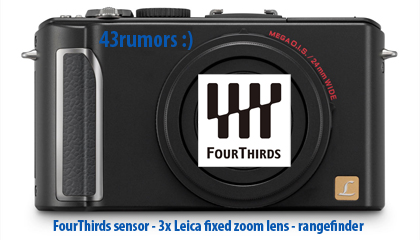
My previous post talked about why SLD or EVIL camera would face limitations in terms of miniaturization due to large lenses. It so happens that a few weeks after that post, a very credible rumor has emerged here that Panasonic is working on a compact non-interchangeable lens camera with a micro fourthird sensor and a Leica designed 3x zoom lens.

If we need another set of alphabets in our soup, I would call it CLSZ - The Compact Large Sensor with Zoom :)

Despite the success of SLD and EVIL cameras, I believe that they are still not the killer products which would truly dominate the prosumer market. Together with some of the factors I have mentioned my previous post, here is a list of reasons why I think this Panasonic CLSZ cameras would be that killer product.

  • The Non-Interchangeable Advantage -As I have mentioned, SLD/EVIL cameras are system based and prosumers with dSLRs may not want to invest in another system. Especially when the new system often have a much more limited lens selection
  • Size Matters, really - SLD/EVIL zoom lenses are often not small, this defeats the purpose of such systems. Pancake prime lenses may go well with pros but some PnS upgraders (which forms the bulk of the target market) would definitely prefer zoom lenses.
  • Convenience - CLSZ cameras would likely fit into a small pouch or even the pocket. SLD/EVIL cameras would require an dSLR like bag especially if more than one lens is required.
  • Complexity (of SLD/EVIL) - Most PnS upgraders merely want a PnS like camera with superior image quality. They do not want the complexity of system cameras. Many SLD/EVIL owners do not think they will change the lens at all. This explains the huge amount of interest in the likes of Canon G11/S90, Panasonic LX3 and Samsung EX1.
  • Price/Performance - The interchangeable capabilities would mean that SLD/EVIL would cost a lot more than a competing PnS. Fixed lenses have a advantage of being easier/cheaper to design, more compact and may even provide much better performance than an equivalent interchangeable zoom lens.
Some of the downside of CLSZ are

  • Limited zoom range - Personally, I feel that the 5x zoom lens of the Canon G10/G11 is about as adequate as it gets in such a compact camera. The announced 3x seems a little limited. Although Tele/Wide converters + adapters add to the total weight & size of the package, they are most definitely still simpler, cheaper and lighter than an interchangeable lens system.
  • Performance - So far, most compact with large sensor cameras like Ricoh GXR, Sigma DP1/DP2 and Leica X1 are very slow cameras. Given Panasonic's track record in terms of m4/3 camera AF speed, I am confident a company such as Panasonic can do better than most in terms of AF performance.
  • Accessories - The prosumer market segment, as the name suggests is made of professionals and enthusiasts. It means that while most of the enthusiast would want an easy to use camera, there are times when the professionals would want something relatively advanced. As mentioned earlier, Wide/Tele adapters, flash, and other accessories have to be sufficient to meet the requirements of the wide range of users in this segment. I know this contradicts my earlier comment about wanting to make this group of cameras simpler and cheaper, but hey this is a very confusing segment... Options are often very welcomed. This is where the accessories come in to fill the gaps.
If the rumor is true, once again, it seems like Panasonic has taken the lead in creating a very unique product aimed at changing the rules of the game in this market segment. After only a few weeks of my writing about what I would love to see in a camera like this, Panasonic has announced something so close to what I envisioned. That truly impressed me.

Now, with such a great track record with the G series, what can Canon do to try to catch up? I would really really love to see the G series with a larger sensor, improved performance while keeping most of the features that they currently have, including the very impressive zoom range.

Tuesday, June 1, 2010

Why are SLD/EVIL cameras not small?.. and what should Canon do about it?


When Panasonic's first EVIL camera, the G1 first appeared, I was one of the first to buy it. However, I was contemplating hard whether to get the LX3 or the G1 to complement my dSLR, the Canon 450D (at that time). The promise of an ultra compact system with capabilities of a dSLR was too hard to resist.

The reality is that the EVIL/SLD type system cameras are not actually very small. Sure, if you look at them in some comparison pictures, they do look like the designers have shaved off quite a bit of mass versus their dSLR counterparts. The reality is, however, they are not pocket-sized small.

My thinking is that for anything that is not pocket-sized small, you will need a pouch or a small bag to carry and if you need a small bag to carry them, it will not make too much difference if you carry a marginally larger pouch or a smaller one.

The latest Sony NEX5 has probably come closest to what is thought as a PnS sized system camera with dSLR capabilities. Yes, it is.... but only for the body. When you put on a zoom lens, like the 18-55mm kit, again, it is no longer that small.

Canon and Nikon are still dragging their feet when it comes to SLD/EVIL type camera. Why? Perhaps they want to strategize. Perhaps, their answer is already there...

It is easy to think why Canon should still focus on the Powershot G series type camera (and Nikon, the P6000). Here are the reasons why:

1) EVIL/SLD are system cameras, so consumers need to invest in the system. Flash, EVF, lenses, lenses, lenses.... Unfortunately, most EVIL/SLD lenses are NOT compatible with their professional brethens. If consumers were to invest in a system, they would want to consider potential upgrades into prosumers level equipments. If on the other hand, consumers invest in only one vacation lens, like the Sony 18-200 or Panny 14-140mm which I believe many would do, then it defeats the purpose of a system camera. Flexible cameras like the G11 comes with a compact fixed lens (28-140mm) which is more than enough for most vacationer. If more reach is required, there is always that tele-converter.

2) Size of the Sensor - While the APS-C and 4/3 sized sensors give the EVIL/SLD advantages in terms of Image Quality over PnS, it is also their curse. Larger sensors require larger lenses. While some manufacturers such as Panasonic does in-camera processing to fix lens issues, thus allowing smaller lenses to be made, there is a limit to how much sacrifice can be made in terms of quality. Smaller 1/1.7" sensors used in advanced PnS is probably the sweet spot in the compromise between sensor size vs lens size. Despite being almost the same size as the GF-1 body, the G11's lens is fully retractable, thus giving it a huge size advantages when compared to the GF-1 + Kit lens. Although some reviewers feel that the GF-1's sensor is still ahead of the Canon G11's, others feel that if shot in the RAW format, the performance gap is not as big as some might think.

3) Accessories - The main advantage of the SLD/EVIL cameras is the ability to mount external flashes and remote triggers. Advanced prosumers such as Panasonic LX3 and the Canon G11 can do the same (except for triggering which has been removed from the G11. Why Canon?!). These advanced prosumers can also accept adapters for filters, wide angle and tele converters, which expands the capabilities of such cameras.

4) Speed and Features - Advanced prosumers can shoot at shutter speed of about 1/4000 (G11) and 1/2000(LX3). This is similar to the likes of GF-1, NEX-5, EP-1 and EP-L1 (1/2000). Although the continuous shooting and shot to shot time of the G11, and to a certain extend the LX3, is still a bit lacking. I believe that is a technical challenge that can be overcome if given the right motivation and budget.

Ok, so some of you may say that the G11 is not actually pocket-sized as well. Hey, I managed to stuff it into my bermudas pants pocket and walk around for a day in the mall without being arrested for obscenity. That's something I probably cannot do with the NEX5+18-55mm.

So there I have said it, I think the G11/LX3 type camera is actually a better solution than the EVIL/SLD type systems when it comes to portability vs performance. I do admit that the image quality of such prosumer PnS cameras leave a lot of room for improvement, especially when compared to the APS-C or m4/3 models. Therefore, manufacturers such as Canon may very well design themselves a winner if they take the G11 and slap on some improvements such as:

A) A Slightly larger sensor - This would be a challenge but I think this market segment has just been pushed into the limelight. Manufacturers such as Canon with their own sensor technology cannot hide behind Sony's off-the-shelves sensors anymore. They need to create their own sensor for this category. I think a 2/3" or 1" type sensor would be quite interesting. It may be able to close the gap against the m4/3 while maintaining a reasonable overall size.

B) A Faster Performance - Features wise, the Canon G series and the Panasonic LX series are already very close to entry level dSLR. What they need is the speed to match. A 3 fps shooting speed, a shot to shot time of < 1 sec and and Af speed of about 0.4s to 0.5s would put them in a very good position versus the EVIL/SLD.